
Alexandru Bulacu
Executive DirectorSome description text for this item
Perspective on Wilderness
"When people speak about wilderness, the first images that may come to mind are hidden places and species living in the dim light of forests or near snow-covered mountain ridges, far from human sight.
For me, wilderness means pure nature, places rarely reached by people. It is a landscape that appears silent, yet resonates with the most beautiful bird songs, the calls of red deer, or the playful presence of bears.
It is a living space where everything is connected, interdependent, and intact; where water can be drunk directly from the palm of one’s hand, without the need for treatment.
It is also the place where humans find rest or walk barefoot through grass, and where all animals raise their young, teaching them how to survive and how to become rightful and discreet co-inhabitants of a planet that we, as humans, have excessively used."
Professional Experience
- Wildlife Zoology Expert – Wildlife Management Consulting SRL (2020–present)
- Mentor – Interact Club Hațeg (2017–present)
- Senior Rewilding Officer – LIFE RE-Bison – Urgent actions for the recovery of European bison populations in Romania (2012–2017)
- Community Development Facilitator – LIFE Connect Carpathians (2014–2016)
- Project Manager – “Votes, Children and Flowers for Retezat” (2009)
- Project Assistant – “Sustainable Use of Natural Resources in the Vicinity of Retezat National Park” (2007–2009)
Education and Professional Training
- Master’s Degree in Hospitality and Tourism Management, Faculty of Sciences, University of Petroșani (2009)
- Bachelor’s Degree in General Nursing, Faculty of Medicine, Pharmacy and Dental Medicine, “Vasile Goldiș” Western University of Arad (2009)
- Teaching and Educational Psychology Certification, Department for Teacher Training, University of Petroșani (2006)
- Bachelor’s Degree in Psychosociology, Faculty of Sciences, University of Petroșani (2006)
- Certified General Nurse, Hunedoara Post-secondary Medical School (1993)
- Veterinary Technician, Agroindustrial High School Hațeg (1988)
- Live Animal Transport Attendant, Academic Foundation for Domestic and International Transport, Bucharest (2017)
- Community Development Facilitator, ProPark – Foundation for Protected Areas (2015)
- Guesthouse Administrator, SC DAG IMPEX SRL, Bucharest (2011)
- Project Manager, Smart Training Solutions, Bucharest (2010)
- Professional Competency Evaluator, SC European Professional System SRL, Șoimuș (2010)
- Trainer, Smart Training Solutions, Bucharest (2009)
- Trainer of Trainers, SC Profi Serv Group SRL, Deva (2006)
- Tour Guide, Romanian Mountain Guides Association, Brașov (2002)
- Senior General Nurse, National Center for Advanced Training of Medical Assistants, Bucharest (1999)
Adrian Hăgătiș
Conservation DirectorSome description text for this item
Perspective on Wilderness
“Wilderness is perhaps one of the most intriguing subjects to address on a continent such as Europe, where its presence is often perceived as unlikely and controversial.
I believe, however, that there is a real potential for humanity to reach, in the near future, a level of social maturity combined with technological development that is sufficient to allow the acceptance of the idea that nature needs its own space and its own natural processes.
Embracing wilderness does not mean ‘taking something away’ from ourselves or slowing down our evolution as a species. On the contrary, in my view, the promotion of wilderness areas is both a professional and a personal goal. In an ideal world, wild nature plays a crucial role in ensuring human well-being, offering something that we cannot artificially construct or obtain in our relationship with nature: balance.”
Professional Experience
- Nature Conservation Consultant (2011–present)
Key consultancy assignments include:
- Coordination of the development and implementation of digital timber traceability systems in Gabon and Peru, in cooperation with national forest management, fiscal, and customs authorities.
Contractors: Code4Nature Inc. and Environmental Investigation Agency, USA (2019–present) - Habitat quality assessment study of riparian ecosystems along the Dumbrăvița–Racoș sector of the Olt River and the Gura Apelor Dam–Hațeg sector of the Râul Mare River, aimed at identifying priority areas for ecological restoration and potential reintroduction of the European mink (Mustela lutreola).
Contractor: Fauna & Flora International Romania (2020) - Preliminary stakeholder analysis covering 27 local communities in the Făgăraș Mountains, focusing on wilderness protection and the proposal to establish a national park.
Contractor: ProPark (2019–2021) - Selection, transport, reintroduction, and monitoring of 48 European bison (Bison bonasus) individuals in two reintroduction areas in the Southern Carpathians, under the EU-funded LIFE project RE-Bison.
Contractor: WWF Romania (2018–2019) - Contribution to the development of the “Capacity Needs Assessment and Training Strategy for Protected Areas” covering Morocco, Algeria, Tunisia, Libya, and Egypt.
Contractors: ProPark Foundation for Protected Areas and IUCN Centre for Mediterranean Cooperation (2018) - Coordination of a preliminary study identifying 257 hectares of virgin and old-growth forests in the Făgăraș Mountains.
Contractor: Czech University of Life Sciences Prague (CULS), Czech Republic (2018) - Stakeholder analysis and assessment of social acceptance of large carnivores within the EU-funded LIFE project Connect Carpathians.
Contractor: Fauna & Flora International (2018) - Contribution to the development of the “Guide for the Strategic Planning of Game Wildlife Management”.
Contractor: ProPark Foundation for Protected Areas (2015) - Translation from English into Romanian of FSC forest certification standards.
Contractor: Romanian Forest Certification Association (2015) - Translation from English into Romanian of the IUCN Guidelines for Applying Protected Area Management Categories.
Contractor: WWF Danube-Carpathian Programme, Romania (2011)
Coordination and Strategic Roles
- Coordinator, Rewilding Europe Initiative in the Southern Carpathians, within WWF Danube-Carpathian Programme Romania (2011–2017)
- Collaborator within the working group for defining criteria for wilderness area identification in Europe, established and coordinated by the Wild Europe Initiative (2011–2013)
- Project Coordinator for the identification and mapping of wilderness areas in the south-western Southern Carpathians, funded by the MAVA Foundation and implemented by WWF Danube-Carpathian Programme Romania (2011–2012)
Education and Professional Training
- Research Master’s Degree in Natural Sciences, Environmental Dynamics, and Natural Hazard Processes, Paris IV-Sorbonne University, Department of Geography, France (2004–2005)
- Bachelor’s Degree in Geography, West University of Timișoara (2001–2004)
- Certified Trainer, ProPark Foundation for Protected Areas, Brașov (2014)
- Live Animal Transport Attendant Certification, Academic Foundation for Domestic and International Transport, Bucharest (2017)
Alex Moza
PresidentSome description text for this item
Perspective on Wilderness
“Wilderness without wildlife is nothing more than a picturesque landscape. Every time I venture into nature, my thoughts return to a moment from two decades ago, when I was camping on the bank of a river. That memory remains deeply engraved in my mind and soul, not because of the beautiful scenery, but because of my first encounter with a true emblem of the wild — the fox.
A graceful flash of colour that taught me the true meaning of wilderness: a place where birds have been singing the same song for thousands of years.
For me, nature is a sanctuary — a space where I detach from everything artificial and allow my ‘wild’ instincts to reawaken. As a species, humans are not the masters of the Earth; we belong to it. Therefore, it is our responsibility to share it with wild animals and, above all, because we are rational beings, to protect them.”
Professional Experience and Education
- Assistant Professor, Faculty of Veterinary Medicine, Timișoara (2022–present)
- PhD in Veterinary Medicine (2020–2024)
- Doctor of Veterinary Medicine (DVM), Faculty of Veterinary Medicine, Timișoara, University of Life Sciences “King Michael I” (USAMVBT) (2020)
- Volunteer, Romanian Wilderness Society (2019–2023)
Alexandra Maria Duma
Project managerSome description text for this item
Perspective on Wilderness
“When I try to imagine what wilderness means to me, I see a dense forest, where only a few rays of sunlight manage to break through. I take a few steps along a narrow path and hear something moving nearby.
I feel slightly uneasy, filled with respect and curiosity at the same time. This is nature — alive and mysterious — something we cannot control.
Wilderness is the part of ourselves that we have yet to fully discover.”
Professional Experience and Education
- Project Manager, Romanian Wilderness Society (2023–present)
Projects: “Restoring the European mink to the Romanian Carpathians” and “Identifying barriers for removal to restore habitats and biodiversity in the Upper Mureș Basin” - Master’s Degree in Wildlife Ecology and Management, University of Natural Resources and Life Sciences (BOKU), Vienna (2022–2025)
- Doctor of Veterinary Medicine (DVM) – Companion Animals (2020–2023)
Specialization in Remote Anesthesia - Bachelor’s Degree in Veterinary Medicine, Faculty of Veterinary Medicine, Cluj-Napoca (2012–2018)
- Volunteer, Romanian Wilderness Society (2013–2018)
Iuliana Bogdan
Consiliul Director - JuristSome description text for this item
Gabriel Chișamera
consiliul director - biologSome description text for this item
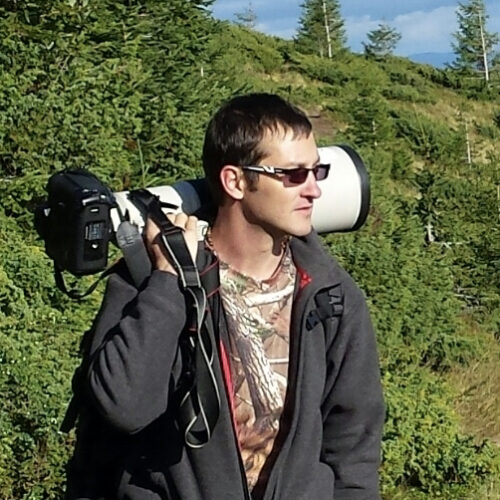

Voluntari SRS
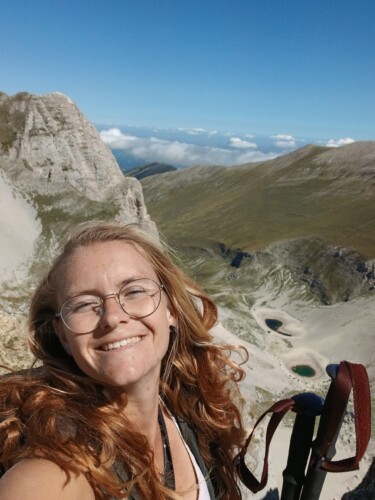
Isabel Wettering
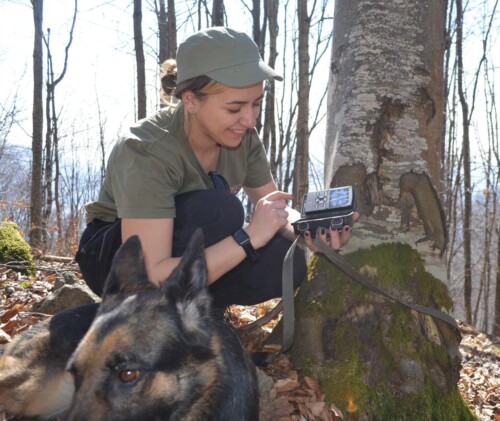
Anastasia-Elena Anescu
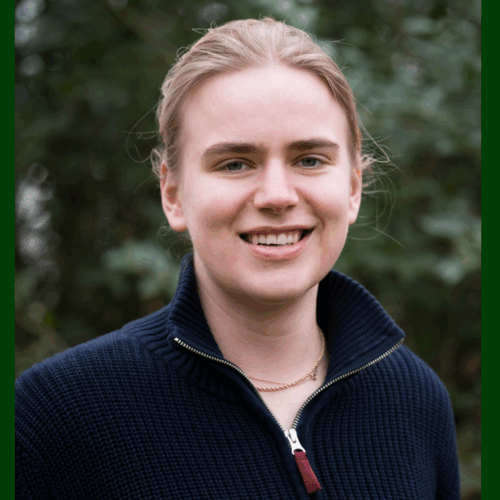
Antonia Bobbert

Marinel Năstăsie
Denisa Condescu

Vitali Elade

Martin Hecker
Albert Pollak
What volunteers say about us:
Marion Möstl studied Environmental and Bioresource Management and is now training to become a musical actress. Marion war a RWS volunteer in a field internship in march/april 2024 in the Project Restoring the European Mink to the Romanian Carpathians.
“I volunteered at RWS to learn practical skills in wildlife-conservation field work, to spend time in nature and to have an adventure. I definitely got all that and what I didn’t expect is how much work it is to generate scientific information about wild animals. Later, it helped me with my thesis because I experienced the steps of a scientific project: preparations, going in the field, how to collect and manage data and to be creative, because a lot will be unexpected…
Living with this research group felt like a small world and like a school of life – you form friendships, feel excited or exhausted and I learned a lot about myself. For example, that pleasant team dynamics are very important for me to feel good at work.
More than a year laten, I’m still thinking about this experience a lot and all the practical and technical skills I learned are still in my head as well as knowledge about wildlife and the complexity about conservation work. I use these learnings to improve forest management back in Austria. Now studying at an Academy of Musical Theatre is not a change in direction for me, I always had a big love for arts plus the environment, and I could never leave one interest behind. So, what I now know is that no matter how important environmental protection to me is, I also need to work as an artist.
Erwan Rouillon – student at the Veterinary Medicine Faculty in Timisoara was a RWS volunteer in a field internship in february/march 2025 in the Project Restoring the European Mink to the Romanian Carpathians.
“My volunteering with the SRS Wild Association had an impact on my vision of fieldwork and conservation in Europe. It was the first time I had a concrete understanding of the logistical, human, and financial complexity involved in a project monitoring endangered wildlife species. Understanding this concrete sequence of actions allowed me to see conservation no longer as an abstract idea, but as a collective, pragmatic effort rooted in the reality on the ground. This experience fueled a broader reflection on our responsibility, as Europeans, in the face of the silent disappearance of our wildlife. Since then, I have had the opportunity to obtain other internships in this field, thanks to the experience and credibility acquired here. In hindsight, this volunteering was a real starting point: it shaped my skills, clarified my ambitions, and left a lasting imprint on how I see my future in biodiversity protection.”
Delia Cretu studied MSc Multipurpose Forestry at Transilvania University and did an Erasmus-funded internship in camera trapping with Rewilding Spain. Delia was a RWS volunteer in a field internship in february/march 2025 in the Project Restoring the European Mink to the Romanian Carpathians.
“Two years ago I became a member of the European Young Rewilders network and my interest in the topic has been growing steadily ever since. This is why volunteering with SRS was a very valuable experience for me, a chance to see what it is like to prepare a reintroduction project on the ground. I really enjoyed the fieldwork and especially the relationships we developed within the team. I even enjoyed the struggles, the difficulties and learning how to overcome them (at least in retrospect 🙂 ). But what really stayed with me were the discussions about what a reintroduction means, what it needs in order to be successful, the debates over various monitoring methods, their pros and cons, and above all the vision of landscape connectivity. I am currently building on the skills and experience gained in RWS by being an intern with Rewilding Spain and while I’m not exactly sure what’s coming next… I am actively looking for ways to continue on this career path.“